

There's a word that shows up constantly on the spec sheets of mid-to-high-end watches, and almost nobody really explains it: chronometer. It sounds technical, it sounds like precision, but what does that actually mean for the person who's going to wear the watch every day? In this article, we'll cover where the term comes from, what sets a chronometer watch apart from a regular one, and where this kind of precision still matters today.
The watch remains one of the most worn accessories in the world, for both men and women, and it's not just about telling time. It also says a lot about the wearer's style and attention to detail. Within the huge range of watches on the market, the chronometer watch is one of the most respected among people who value precision.
What is a chronometer watch
A chronometer watch is a high-precision watch designed and tested to meet criteria set by an official timekeeping organization. These criteria define the accuracy and performance levels a watch has to hit to be certified as a chronometer, including the maximum allowed deviation, measured in seconds per day, between real time and the time the watch shows.
In practice, "chronometer" isn't just a fancy word on the dial. It's a quality seal that confirms that specific movement was tested and passed, rather than simply built to a generic quality standard.
The origin: from maritime navigation to modern precision
The first chronometer watches date back to the 18th century, developed to solve a very concrete problem: maritime navigation. Sailors needed a reliable clock to calculate longitude while out on the open ocean, something that was practically impossible to do with any confidence without a precise instrument. Chronometer watches were built specifically to solve that problem, allowing sailors to pinpoint their ship's position accurately.
Today, that level of precision isn't a matter of life and death at sea anymore, but it's still relevant in contexts like sporting events (car racing, track and field), aviation, navigation, and science, anywhere measuring time accurately still makes a difference.
Chronometer isn't the same as chronograph
This is probably the most common mix-up around this term, and it's worth clearing up before we go further. A chronometer is about the accuracy of the movement, it's a precision rating. A chronograph, on the other hand, is a function: it refers to a watch that has a built-in stopwatch, usually with extra pushers and subdials on the face, letting you time intervals the same way you would with a separate stopwatch.
A watch can be a chronometer without being a chronograph, a chronograph without being a chronometer, or both at once. They're independent concepts, even though the names might suggest they're related.
How it's built: mechanical vs. quartz
Chronometer watches are designed to run with high precision and can be adjusted in tiny increments to stay accurate over long periods. They're typically built with high-quality components, including precision mechanical movements, springs, gears, hands, and carefully calibrated dials.
Mechanical chronometer watches are especially prized by collectors and enthusiasts. They run on a manual or automatic winding mechanism and are designed to hold their precision over many years of use.
That said, plenty of modern, high-quality watches are also designed to meet these accuracy standards, and are therefore considered chronometer watches even though they run on a quartz movement. This type of movement tends to deliver impressive accuracy, paired with far simpler maintenance than a mechanical movement requires.
Dicci's Chronometer spec sheet
If you're after a watch that pairs precision with an elegant look, Dicci's Chronometer models were built with exactly that in mind. Here are the specs for the blue dial version:
| Spec | Detail |
|---|---|
| Case diameter | 41mm |
| Case material | 316L stainless steel |
| Strap material | 316L stainless steel |
| Water resistance | 5ATM |
| Movement | Japanese quartz |
| Glass | Mineral glass |
| Extras | Date window |
The use of 316L steel for the case and strap isn't random: it's the same surgical-grade steel we've covered in other articles, resistant to corrosion and safe even for sensitive skin, which makes perfect sense for a piece built for everyday wear.
How to take care of your watch
A watch does more than just tell the time. Often, there are personal memories tied to it, which makes it an object with real sentimental value. With the right care, it's entirely possible to pass it down to future generations. A few simple habits help keep it in good shape:
- Clean the watch regularly, using a soft cloth to wipe dust and dirt off the case and band.
- Every so often, rinse it with mild soap and water to loosen more stubborn grime.
- Get it serviced every two to three years for mechanical watches, or every three to four years for quartz watches.
- Keep it away from magnets, since a magnetic field can throw off the accuracy of the movement.
- Check your model's water resistance rating before swimming or showering with it, and keep in mind that seals and gaskets can lose effectiveness over time, even if the original rating hasn't changed.
- Protect the crystal from impact by avoiding knocks against hard surfaces.
- Store the watch in its original box when you're not wearing it, rather than leaving it resting on the crystal or its side.
- Avoid prolonged sun exposure, since heat can shorten battery life on quartz models.
- Avoid contact with chemicals, perfume, or lotion, especially if the model has a leather strap.
Dicci's Chronometer models


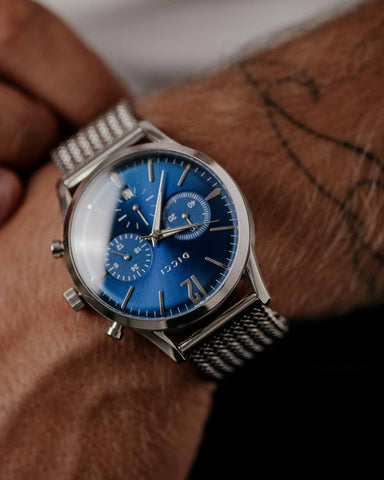
All models feature a case and bracelet in 316L stainless steel, a date window, and water resistance, so choosing between them really comes down to personal style rather than quality. Shop the full Chronometer collection.
Frequently asked questions
Is a chronometer watch always mechanical?
No. While the term originated with mechanical movements, plenty of quartz watches today are also certified as chronometers, as long as they meet the same precision standards.
What's the difference between chronometer and chronograph?
Chronometer refers to the accuracy of the movement. Chronograph refers to a specific function, timing intervals using extra pushers on the watch. A watch can have one feature, the other, both, or neither.
Can I swim with Dicci's Chronometer watch?
With a 5ATM rating, the model can handle splashes, rain, and hand-washing without issue, but it's not recommended for swimming or diving, activities that call for higher water-resistance ratings.
How often should I get my watch serviced?
For mechanical watches, every two to three years is recommended. For quartz watches, like Dicci's Chronometer models, every three to four years is usually enough.
Why should I keep my watch away from magnets?
A magnetic field can magnetize internal components of the movement, causing the watch to start running noticeably fast or slow, even on an otherwise high-precision model.


0 comments